
Suez Canal disruption: Five key considerations for shippers navigating Red Sea risks
Attacks on Red Sea vessels have pushed major ocean carriers to divert ships from the Suez Canal, prompting surcharges and extended transit times. Industry experts outline five critical questions shippers must address, from alternative routes and rate trends to cargo exposure and insurance risks.
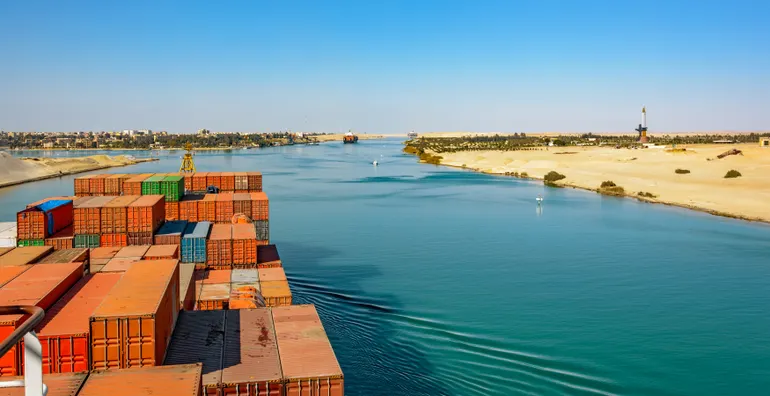
As the year draws to a close, shippers are confronting yet another supply chain disruption as the Suez Canal becomes an increasingly untenable route for cargo movement. Recent attacks on vessels transiting the Red Sea have forced major carriers to reroute or pause operations, leaving logistics managers to activate contingency plans while an international security response is being coordinated.
Supply Chain Dive consulted multiple shipping and logistics experts to address the most pressing concerns facing shippers. The following five questions and answers offer guidance on where, how, and when to reroute cargo amid ongoing uncertainty.
1. How are carriers responding?
Carriers are moving swiftly in response to the threat of Houthi-led attacks on commercial vessels. According to the Suez Canal Authority, approximately 55 vessels were rerouted via the Cape of Good Hope route beginning Nov. 19 — a figure the authority notes is "significantly low" compared with the 2,128 vessels that transited the canal during the same period. For context, 23,851 vessels used the Suez Canal in 2022, averaging 68 ships per day.
Nathan Strang, director of ocean freight for the U.S. Southwest and SMB at Flexport, wrote in a Tuesday LinkedIn post that longer transit times are expected in the medium term for shipments that have not yet departed. "How much depends on what the vessels' original routing was and when the vessel diverted. Keep in mind that some of these vessels were already diverted away from the Panama Canal," he added.
Actions from ocean carriers in response to the vessel attacks
| Ocean Carrier | Action Taken | Surcharges |
|---|---|---|
| Maersk | Instructing all Maersk vessels in the area bound to pass through the Bab al-Mandab Strait to pause their journey until further notice | Emergency Risk Surcharge, effective Jan. 8, 2024 |
| CMA CGM | Rerouting several vessels from their intended route through the Cape of Good Hope | Several surcharges: A RED SEA surcharge, effective Dec. 20, and a contingency surcharge effective immediately |
| Hapag-Lloyd | Rerouting vessels away from the Suez Canal and the Red Sea using the Cape of Good Hope | War Risk Surcharge, effective Jan. 1, 2024 |
| MSC | MSC ships will not transit the Suez Canal Eastbound and Westbound and instead will use the Cape of Good Hope | Contingency Surcharge, effective Dec. 23 |
| ONE Line | Rerouting vessels away from the Suez Canal and the Red Sea using the Cape of Good Hope | None as of Dec. 20 |
| Evergreen | Temporarily suspending Israeli cargo and rerouting vessels via the Cape of Good Hope | None as of Dec. 20 |
| OOCL | Temporarily suspending Israeli cargo | None as of Dec. 20 |
| ZIM | Began rerouting some of its vessels in late November from the Arabian and Red Seas | War risk premium surcharge, effective Nov. 22 |
SOURCE: Ocean carriers
2. What alternatives exist?
Shipping lines can bypass the Suez Canal by routing around the Cape of Good Hope in South Africa. However, this safer alternative carries significant additional costs and transit times. A container ship traveling from Singapore to Rotterdam via the cape adds roughly 3,500 kilometers to the voyage, according to Michael Zimmerman, partner in the strategic operations practice at Kearney, a global management consulting firm.
"The extra fuel will cost an additional $500,000 to $1,000,000 and shippers have the inventory on their books [for] an extra 20-30 days," Zimmerman said in an email.
For the Asia to U.S. East Coast route, shippers could also consider modal shifts, leveraging truck and rail intermodal moves from the U.S. West Coast, Strang said during a Wednesday webinar.

Yet other experts cautioned that these alternatives are imperfect, as shipments will face delays regardless of the chosen path. In emails to Supply Chain Dive, forwarders said they were working with customers to assess near-term freight risks and redirect cargo to alternative routes.
C.H. Robinson Operations Supervisor Matthew Burgess said their plans include a combination of sea and air solutions via Colombo, Dubai, or the U.S. West Coast, in addition to traditional airfreight options and expedited inland services once cargo reaches port. Meanwhile, a Kuehne+Nagel spokesperson said the company was encouraging customers to use a sea-to-air solution, where eastbound shipments could arrive from Asia by sea to Dubai, then continue by air.
"This allows for a faster transit time compared to sea freight and a more sustainable and cost-effective solution than direct air freight," the forwarder said in an emailed statement to Supply Chain Dive.
3. What could happen to ocean freight rates?
In a weekly emailed update, Freightos said rates will almost certainly increase from Asia to Northern Europe. Ocean carrier ZIM, which began diverting its vessels that normally use the Red Sea last month, has already raised rates for its Asia to Mediterranean service. Shippers must now pay between $3,300 and $3,400 per forty-foot equivalent unit for that service, according to Freightos.
Spot rates are also climbing. Rates from Asia to the U.S. East Coast and West Coast have already increased slightly, with more hikes likely, Lars Jensen, CEO and partner at Vespucci Maritime, said in a Thursday LinkedIn post referencing Drewry's WCI Index. However, he noted that current rates remain comparable to levels seen earlier this year.
While rates are rising, experts said shippers should not expect increases as severe as those seen in 2021, when the Suez Canal was blocked for a prolonged period. "Because of the excess capacity available to address the disruption – something that was not the case during the Suez Canal blockage in 2021 – it is possible that the industry will avoid the extreme rate spikes like those seen during the pandemic," Freightos Head of Research Judah Levine said in an emailed update.
4. What goods could be most affected?
During the 2021 blockage, experts told Supply Chain Dive that nearly everyone could be affected in some way, given the scale of the trade route. Companies such as Walmart and Ikea, along with the automotive and technology industries, may be particularly exposed.
The Suez Canal is a critical artery for Asia-Europe trade, which represents 12% of vessel routes and 30% of global container traffic, according to Lawson Brigham, a retired U.S. Coast Guard captain who wrote on the topic in the U.S. Naval Institute's Proceedings Magazine.
Consequently, experts said the Asia-to-Europe trade lane will likely suffer the most, as it is the shortest available sea route. "The market anticipates that especially in Europe which is on the receiving end of import containers from the Middle East, India, southeast Asia and China, that container scarcity will lead to an increase in container prices and the market," Christian Roeloffs, CEO and founder of Container xChange, said in an analysis shared with Supply Chain Dive.
In the U.S., goods sourced from Asia – such as apparel, toys, and electronics – and shipped to the East Coast may also be affected, Srini Rajagopal, VP of logistics product strategy at Oracle, told Supply Chain Dive. Exports from the East Coast, including grains, liquefied petroleum gas, and liquefied natural gas, may also face disruption.
However, any commodity that can be moved via alternative modes, such as air, may escape severe disruption. Zimmerman said that list is small, though, and "only the most expensive goods that move by air or domestically produced and consumed goods or goods that can move internationally by truck will remain unaffected."
5. What else should shippers know?
Shippers considering routes from Asia to the U.S. Gulf Coast should be aware that these trade lanes may also experience delays due to ongoing drought restrictions at the Panama Canal. "The Panama canal is still experiencing a drought which is resulting in less vessel slots being available on a daily basis," Anders Schulze, SVP and global head of ocean freight at Flexport, said during a webinar. "The number of slots are expected to decrease going into February, so the Panama delays could increase over the next 6-8 weeks."
Beyond alternative shipping routes, shippers should also revisit their material sourcing strategies, Rajagopal said. "This includes multi-sourcing (using multiple suppliers for a certain material in case one of the suppliers is unavailable) and sourcing materials in-region (using sources that are physically closer to the manufacturing hubs)," he explained.
Additionally, shippers should scrutinize their insurance premiums. While some small niche carriers may still offer Asia-to-Mediterranean service via the Suez Canal, shippers must recognize the inherent risk, Jensen said during a Flexport webinar on Wednesday. "You do risk losing your cargo, but I would also read insurance premiums extremely carefully to see if you are covered in a situation where the risk is this obvious," Jensen said. "I would not be surprised, as some might find it impossible to get their cargo insured at all."
Kelly Stroh contributed to this story.