
Suez Canal Risk Escalates: Five Key Questions for Shippers Coping with Disruptions
As the year-end approaches, Suez Canal routes face severe challenges due to Red Sea attacks. Approximately 55 vessels have been rerouted via the Cape of Good Hope, with multiple shipping lines announcing diversions or suspensions of Red Sea transits and imposing surcharges. Based on interviews with experts from organizations such as Flexport, Kearney, and Freightos, this article analyzes five major issues: carrier responses, alternative routes, freight rate trends, affected cargo types, and insurance risks, providing decision-making references for shippers.
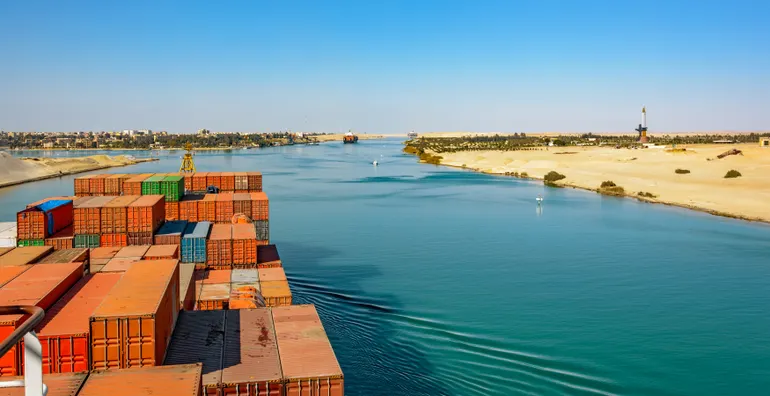
As the year-end approaches, the freight industry once again faces major uncertainties—the safety of transit through the Suez Canal, a key route for Asia-Europe shipping, is under serious threat. Earlier this month, attacks on commercial vessels in the Red Sea have forced several major shipping lines to suspend Red Sea transits or opt for diversions. Although the international community is coordinating joint escort operations to ensure the safe passage of commercial vessels, logistics managers still need to assess and activate contingency plans before the situation becomes clear.
Industry media Supply Chain Dive interviewed multiple shipping and logistics experts on this matter, addressing the most pressing concerns of cargo owners, and compiled the following five questions and answers to help cargo owners decide where, how, and when to reroute their cargo.
1. How are shipping lines responding to the current situation?
Shipping lines have responded swiftly to the potential risk of Houthi attacks on cargo vessels. Data from the Suez Canal Authority shows that since November 19, approximately 55 vessels have been diverted to the Cape of Good Hope route, while the total number of vessels transiting the canal during the same period was 2,128. For reference, a total of 23,851 vessels passed through the Suez Canal in 2022, averaging about 68 per day.
Nathan Strang, Director of Ocean Freight for Flexport's Southwest U.S. and SME division, stated in a LinkedIn post on December 19 that for cargo not yet departed, extended transit times in the medium term are a certainty. He noted: "The extent of the extension depends on the vessel's original route and the actual timing of the diversion. It should be noted that some vessels had already been rerouted due to Panama Canal restrictions."
Overview of major shipping lines' response measures
| Shipping Line | Response Measure | Surcharge |
|---|---|---|
| Maersk | Instructing all vessels in the relevant waters originally scheduled to transit the Bab el-Mandeb Strait to pause navigation until further notice | Emergency risk surcharge, effective January 8, 2024 |
| CMA CGM | Diverting multiple vessels from their original routes via the Cape of Good Hope | Multiple surcharges: Red Sea surcharge effective December 20; contingency surcharge effective immediately |
| Hapag-Lloyd | Diverting vessels via the Cape of Good Hope, avoiding the Suez Canal and Red Sea | War risk surcharge, effective January 1, 2024 |
| MSC | Vessels will no longer transit the Suez Canal east-west, rerouting via the Cape of Good Hope | Contingency surcharge, effective December 23 |
| ONE | Diverting vessels via the Cape of Good Hope, avoiding the Suez Canal and Red Sea | None as of December 20 |
| Evergreen Marine | Suspending cargo to Israel and diverting vessels via the Cape of Good Hope | None as of December 20 |
| OOCL | Suspending cargo to Israel | None as of December 20 |
| ZIM | Diverting some vessels from the Arabian Sea and Red Sea since late November | War risk premium surcharge, effective November 22 |
Source: Individual shipping lines
2. What alternative routes are available?
Rerouting around the Cape of Good Hope in South Africa is the primary alternative to avoid the Suez Canal. However, this safer route comes with additional costs and time. Michael Zimmerman, Partner in the Strategic Operations practice at global management consulting firm Kearney, noted in an email that a container ship rerouting via the Cape of Good Hope from Singapore to Rotterdam would need to travel approximately 3,500 kilometers more.
Zimmerman said: "Additional fuel costs range from approximately $500,000 to $1 million, and cargo owners' inventory holding periods will extend by 20 to 30 days." On Asia to U.S. East Coast routes, cargo owners can also consider switching transport modes, utilizing rail and truck intermodal services on the U.S. West Coast, as Strang suggested in a December 20 webinar.

However, other experts pointed out that these options are not perfect, and cargo delays are inevitable. Multiple freight forwarders told Supply Chain Dive in emails that they are assessing near-term cargo risks with clients and guiding them toward alternative routes. Matthew Burgess, Operations Director at C.H. Robinson, said its options include sea-air combinations via Colombo, Dubai, or the U.S. West Coast, as well as traditional air freight options and expedited inland services upon cargo arrival. A spokesperson for Kuehne+Nagel said the company encourages clients to adopt sea-air solutions—eastbound cargo first travels by sea from Asia to Dubai, then transfers to air.
The freight forwarder stated in an email statement: "Compared to pure ocean freight, this shortens transit time; compared to pure air freight, it is more cost-effective and sustainable."
3. How will ocean freight rates change?
Freightos predicted in its weekly email update that rates on Asia-Northern Europe routes are almost certain to rise. ZIM has already rerouted its vessels, which typically transited the Red Sea, since last month and has raised rates on Asia-Mediterranean routes. According to Freightos data, cargo owners on this route currently pay $3,300 to $3,400 per forty-foot equivalent unit (FEU).
Spot rates have also begun to rise. Lars Jensen, CEO and Partner of Vespucci Maritime, cited the Drewry WCI index in a December 21 LinkedIn post, noting that spot rates on Asia-U.S. East Coast and West Coast routes have increased slightly and may continue to climb. However, he also said current rates remain comparable to levels seen earlier this year.
Despite rising rates, experts caution against expecting extreme spikes like those seen during the prolonged Suez Canal blockage in 2021. Judah Levine, Head of Research at Freightos, analyzed in an email update: "The industry currently has ample capacity slack to absorb this disruption—quite different from the situation during the 2021 canal blockage—so the industry is likely to avoid the extreme rate spikes seen during the pandemic."
4. Which cargo will be most affected?
During the 2021 canal blockage, experts told Supply Chain Dive that given the waterway's enormous scale, almost everyone would be affected to some degree. Retail giants such as Walmart and IKEA, as well as the automotive and technology sectors, may bear the brunt.
The Suez Canal is a critical artery for Asia-Europe trade. According to retired U.S. Coast Guard Captain Lawson Brigham, writing in Proceedings of the U.S. Naval Institute, the Asia-Europe route accounts for 12% of global shipping routes and carries 30% of global container traffic. Therefore, experts believe the Asia-Europe route will be hit hardest, as it is the shortest sea route.
Christian Roeloffs, CEO and Founder of Container xChange, noted in an analysis: "Market expectations, especially in Europe as the receiving end of import containers from the Middle East, India, Southeast Asia, and China, point to container shortages, which will drive up container prices and market freight rates." Srini Rajagopal, Vice President of Product Strategy for Logistics at Oracle, told Supply Chain Dive that U.S. imports from Asia—such as apparel, toys, and electronics arriving via the East Coast—as well as exports from the East Coast including grains, liquefied petroleum gas, and liquefied natural gas, may also be affected.
However, any goods that can be transported via alternative means such as air freight may escape severe impact. Zimmerman noted that this category is very small: "Only the most expensive, air-freight-appropriate cargo, or goods produced and consumed domestically, as well as goods that can be transported internationally by truck, will be spared."
5. What else should cargo owners pay attention to?
Cargo owners planning shipments from Asia to the U.S. Gulf Coast should note that this route may also face delays due to ongoing drought restrictions at the Panama Canal. Anders Schulze, Global Head of Ocean Freight at Flexport, said during a webinar: "The Panama Canal remains affected by drought, with daily available slots reduced. Slot availability is expected to decline further in February, so Panama Canal delays may worsen over the next 6 to 8 weeks."
Beyond managing alternative routes, Rajagopal advised cargo owners to also review their raw material sourcing strategies. He said: "This includes multi-sourcing (maintaining multiple suppliers for a given material to guard against disruption from a single supplier) and regional sourcing (choosing sources geographically closer to manufacturing centers)."
Additionally, cargo owners need to pay close attention to insurance terms. Jensen reminded during a December 20 Flexport webinar that while a few niche shipping lines still offer Asia-Mediterranean services via the Suez Canal, cargo owners must be aware of the risks. He said: "There is a real risk of cargo loss, and I strongly recommend carefully reviewing insurance terms to confirm coverage remains in place given such significant risks. I would not be surprised if some cargo owners find their cargo is simply uninsurable."
Kelly Stroh contributed to this article.