
UPS and FedEx compete for small and medium-sized enterprise customers, while Amazon watches closely
As large customers build their own logistics, switch service providers, and market demand weakens, UPS and FedEx are turning their attention to small and medium-sized business (SMB) shippers. Experts say SMB packages are more profitable and serve as a growth engine for express delivery. UPS enhances services through digital tools and AI, while FedEx attracts customers via network integration and the fdx platform. Meanwhile, Amazon poses a potential threat with its logistics network.
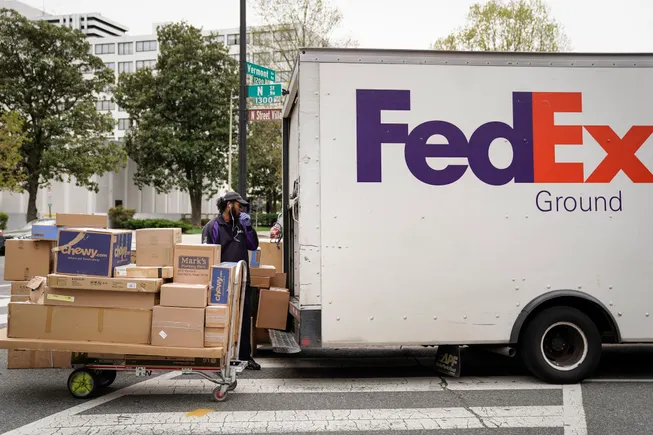
As large customers increasingly build their own logistics networks, switch service providers, and market demand remains weak, UPS and FedEx are competing to capture a larger share of the small and medium-sized shipper (SMB) market.
Experts told Supply Chain Dive that SMBs are driving most of the volume growth in B2C delivery, and their packages are typically more profitable for carriers than those from large customers. This makes SMBs a key target for delivery providers in a weak demand environment.
"Working with large enterprise retailers can generate tens of thousands or even hundreds of thousands of packages per week, but the profit margin on that business is very low," said Scott Lord, founder of Strategic Growth Advisory LLC and former UPS marketing director. "All else being equal, the profit contribution from 10 enterprise packages is equivalent to that of 1 SMB package."
Different considerations for SMBs when choosing a carrier
Compared with large enterprises, SMBs may weigh different factors when selecting a carrier. Industry observers note that ease of integration and an emphasis on reliability over speed are often priorities for smaller shippers when working with delivery providers.
Cost is also crucial for SMBs, said Jay Kent, managing director of SLB Performance. While large customers also consider price, they have more resources to cope with price changes and negotiate more favorable contracts.
"It has a bigger impact on small companies because they suddenly find, 'Why are my costs rising?'" Kent said. "It's not as easy for them to find the reason."
To meet the needs of these shippers, UPS and FedEx have launched multiple initiatives in recent years, hoping to capture a larger share of this high-value customer segment.
UPS accelerates SMB deal process
UPS emphasizes that its integrated network, broad service portfolio, and continuously improving customer service capabilities are key advantages over FedEx. For example, the company is investing in more transparent processes to ensure more consistent pickup times and using AI chatbots to provide rapid responses to shippers, Felicia Adkins, UPS president of U.S. sales, told Supply Chain Dive in an email.
"Although the business scale may be small, expectations are not small, and flexibility is equally critical," Adkins said.
Although UPS's U.S. B2C volume from small shippers declined last year, the decline was smaller than that from large customers,the company said in its annual financial report. UPS partly attributes this to its growing Digital Access Program, which connects carriers with e-commerce platforms, offering rate discounts and other shipper services.
UPS also uses the Deal Manager tool to accelerate transportation agreements with SMBs. The company's sales team uses this tool to obtain real-time pricing guidance, which is especially helpful in winning small customers—95% of deals under $1 million use Deal Manager, UPS Chief Commercial and Strategy Officer Matt Guffey said in March.
"I think UPS is more effective in marketing to this segment and in its ability to retain customers as they grow."
— Nate Skiver, founder of LPF Spend Management
As UPS advances its SMB-related initiatives, the share of SMBs in its volume has increased. SMBs accounted for28.6%of UPS's U.S. volume in 2023, up 60 basis points from the previous year. Adkins said the company aims to eventually increase this share to 40%.
FedEx network integration brings SMB opportunities
Meanwhile, FedEx emphasizes that its ongoing Ground and Express network integration project will improve SMBs' interactions with the delivery giant.
The integration will eliminate separate pickups, which has long been a key shortcoming in FedEx's competition with UPS. It will also save time for shippers who need to split packages between Ground and Express pickups, Randy Scarborough, FedEx vice president of customer engagement marketing, said in an email.
FedEx's recently announcedfdx platformis also expected to help SMBs reach customers more easily. The product integrates end-to-end solutions for e-commerce merchants and leverages information from the millions of packages FedEx handles daily.
"For SMBs, visibility into real-time intelligence will help more easily grow demand, improve conversion rates, fulfill orders, and even streamline returns—all on one platform," Scarborough said.
Scarborough did not detail specific targets for FedEx's growth in SMB volume and revenue share.
Despite FedEx's announcement of multiple initiatives to attract SMBs, Nate Skiver, founder of LPF Spend Management, believes the value of projects such as the fdx platform has not been clearly communicated to customers and shareholders. This gives UPS an advantage, at least in terms of perception, in the battle for volume in this segment.
"I think UPS is more effective in marketing to this segment and in its ability to retain customers as they grow," Skiver said.
Amazon becomes another challenger for SMB volume
FedEx and UPS not only have to worry about each other when attracting SMB shippers. Perhaps the biggest threat in this space is Amazon, which has rapidly grown into a parcel delivery giant with its internal logistics capabilities.
The company offersfulfillment, shipping, and supply chain capabilitiesto a wide range of third-party sellers on its website. According to an announcement by Amazon on Thursday, SMBs in the U.S. market sold more than 4.5 billion products in 2023.
Other carriers are also competing for more shippers in a weak demand environment. The U.S. Postal Service is attracting small businesses through itsConnect Local delivery serviceand is seeing more shippers use itsGround Advantage product. Meanwhile, a range ofalternative carriersare expanding geographic coverage and adding new services.
"If a small merchant is already shipping on Amazon but also has its own direct sales channel, there may be volume available forAmazon Shippingto capture, and that volume may currently belong to UPS, FedEx, or USPS," Skiver said.

