
Chipotle Leverages RFID Technology to Enhance End-to-End Inventory Visibility
Carlos Londono, Vice President of Supply Chain at Chipotle, stated that the company has required all suppliers to attach RFID tags to products, making it the first restaurant chain to adopt the technology at scale. After completing a pilot at 200 restaurants in the Chicago area, the company is on track to roll out RFID to all 3,500 restaurants by the end of the year. The technology has already been implemented in Southern California, significantly improving inventory counting efficiency and traceability. Additionally, Chipotle is advancing a supplier visibility project on the Oracle platform and upgrading its enterprise resource planning (ERP) system.
When supply chain operations rely on third parties, visibility becomes key.
This is a lesson Carlos Londono, Vice President and Head of Supply Chain at Chipotle, knows well as he manages the company's vast and highly third-party-dependent supply chain.
"We are 100% third-party outsourced—all the plants that process our chicken, cheese, and other products are managed by our third-party partners," Londono said.
To address this, Chipotle requires each supplier to affix Radio Frequency Identification (RFID) tags to its products—a type of smart barcode that can automatically identify and track inventory. Although this technology is already common in retail, Londono noted that Chipotle is the first restaurant chain to deploy it at scale.
In a conversation with Supply Chain Dive, Londono highlighted Chipotle's progress in rolling out RFID technology nationwide, how the technology is already working in operations, and future plans to enhance inventory visibility.

RFID Supplier Integration and National Rollout
After a successful pilot at 200 restaurants in the Chicago area, the company is now working to roll out RFID technology nationwide.
"Right after the pilot, we immediately started the rollout from the supplier side, ensuring all suppliers have the necessary technology, software, printers, and infrastructure to support the full deployment," Londono said.
Londono revealed that the company has a pragmatic approach to integrating new technology in restaurants: start with a single restaurant, once the process is streamlined, expand to a group of restaurants, and finally roll out to the entire region.
He said Chipotle recently completed the RFID technology deployment in Southern California, and it is running well. The company has established a phased regional rollout schedule, expecting to complete the switch for all regions by the end of this year.
"Our plan is to have RFID coverage across all 3,500 restaurants by the end of the year," Londono said.
RFID in Limited-Time Offerings
For limited-time offerings like Chipotle's Chicken al Pastor, the supply chain requires extensive preparation about a year in advance, Londono said.
To launch the new product, the company must bring in additional suppliers. Londono pointed out that even if the same limited-time product is repeated annually, the number of required suppliers increases each year.
"We have to bring in new chicken suppliers, new sauce suppliers, and various other resources. This requires a significant investment," Londono said.
During the early stages of new product launches like Chicken al Pastor, available information is often very limited. At this point, closely monitoring inventory becomes crucial, and RFID technology is a solution to fill the data gap.

RFID also helps the company improve product traceability—for example, clearly understanding an item's path through the supply chain network, which distribution center it passes through, and which transportation company carries it.
Additionally, Londono said that once the distribution center sends out shipping data, the speed at which restaurant managers receive inventory information has also greatly improved.
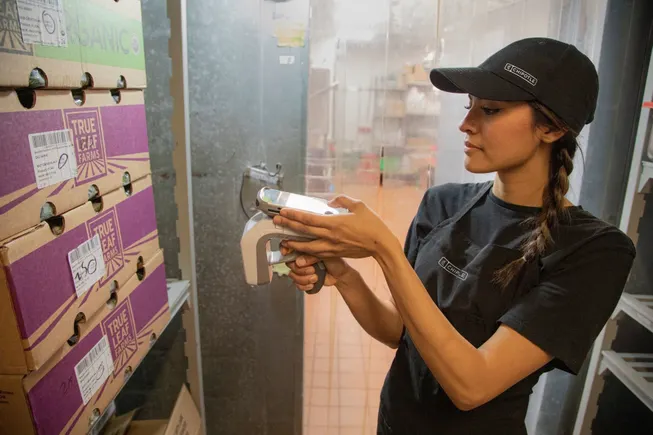
Before RFID technology was applied, Chipotle restaurant managers had to manually scan barcodes one by one, which was time-consuming and labor-intensive. Now, managers simply stand near the product boxes, and the scanner reads the information immediately.
"Whenever there's an opportunity to use technology to reduce labor burden, or improve the efficiency and accuracy of restaurant employees, we fully support it," Londono said.
Next Steps: New Technology on Oracle Platform and ERP Upgrade
Chipotle's pursuit of a technology-driven supply chain goes beyond RFID. The company is currently advancing a project called "Supplier Visibility" based on the Oracle platform.
This project integrates multiple technologies, enabling the company to view inventory, shipments, and supplier information comprehensively upstream. "We are continuously advancing and gradually bringing new suppliers into the project," he added.
At the same time, Chipotle is also using Oracle to enhance and upgrade its existing Enterprise Resource Planning (ERP) system.
Londono said the company's original master data management system has been in service for many years and performed well in the past, but the company has now grown to a point where it needs a "next-generation" solution.
"Any company, especially once it reaches a certain scale, must have some kind of centralized ERP system," Londono said. This is why the company deemed it necessary to enhance its ERP capabilities.
Londono is working with the technology team to explore which additional modules and features can be enabled to continuously enhance the visibility of Chipotle's supply chain.
This article first appeared in our Operations Weekly newsletter. Click here to subscribe。