
Can Trump's tariffs reverse decades of decline in American manufacturing?
President Trump has repeatedly emphasized that tariffs will stimulate investment and job growth in American manufacturing, but economists and industry experts remain cautious. Although giants like Hyundai Motor and TSMC have announced massive investments, small and medium-sized enterprises are holding back due to policy uncertainty. Manufacturing's share of GDP fell from 16% in 1997 to 11% in 2021, and employment dropped from a peak of over 19 million in 1979 to approximately 12.8 million by March 2025. Experts believe tariffs may cause short-term disruptions, but long-term effects are constrained by cost structures, policy continuity, and structural economic changes.
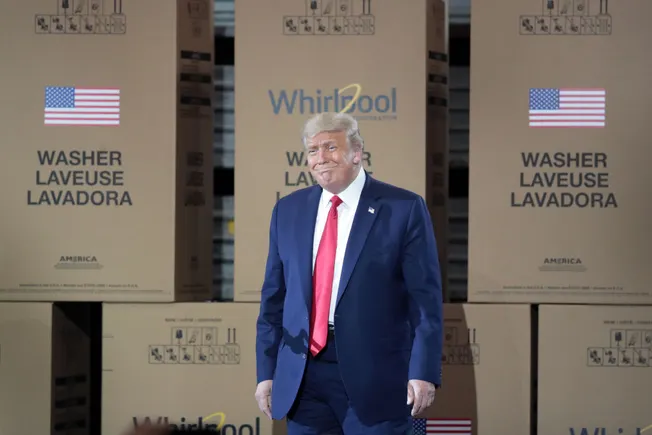
Over the past several months, U.S. President Donald Trump has touted tariffs in numerous comments and posts as an effective means of driving broad investment in American manufacturing.
The president has spoken about these investments bringing substantial job growth and domestic technological strength. Even as economists have expressed concerns that tariffs will raise prices for American consumers, Trump has reiterated that any short-term pain is worth the long-term economic and industrial gains.
"Tariffs are about making America rich again, and making America great again, and it's happening, and it will happen rather quickly," the president said in hisaddress to a joint session of Congressin March. "There'll be a little disturbance, but we're okay with that."
As the administration'slist of tariffsgrows longer, the manufacturing sector is holding its breath to see whether the president's theories about the power of tariffs will prove true.
Can tariffs really bring broad investment?
One of the reasons the president frequently advocates for higher tariffs is to incentivize manufacturers to invest in building new or expanding existing factories in the United States, thereby avoiding high import taxes.
In recent weeks,Hyundai MotorandTaiwan Semiconductor Manufacturing Company (TSMC)announced hundreds of billions of dollars in new manufacturing investments, seemingly confirming this claim. Although neither company explicitly linked the investments to tariffs in its announcements, both unveiled their plans at the White House. When Hyundai made its announcement in March, Trump called the funding "a clear statement that tariffs work very well."
However, across the broader industry, experts are skeptical that small and medium-sized enterprises will make similar investment moves while trade policy remains unstable.
Jeremy Tancredi, partner for operational excellence and supply chain management at West Monroe, said at a recentmanufacturing eventthat uncertainty over whether tariffs will remain at current levels raises the risk for companies investing in expensive facilities or supply chain overhauls. He cautioned manufacturers against taking "drastic" supply chain adjustment measures before policy is standardized and normalized, saying, "Don't make decisions that look good in today's environment but won't be good decisions tomorrow, next week, or next month when the environment changes."
Treasury Secretary Scott Bessent has been an active supporter of Trump's tariffs. In an interview with investment bank Jefferies on April 4, he said tariffs could generate $300 billion to $600 billion in revenue annually and protect domestic industries from global practices the administration deems unfair.
In an interview earlier this month on "The Tucker Carlson Show," Bessent called tariffs "the beginning of a process" aimed at driving American reindustrialization and countering foreign economic systems, such as China's, that subsidize industry.
"If we can put a 20 percent tariff on, have the foreigners pay it, and then use that money to lower the government deficit and keep tax rates low? That's a very unique formula that this country hasn't tried in a long time," Bessent said.
The administration has particularly prioritized expanding domestic semiconductor production, using tariffs to incentivize companies like TSMC to invest in the United States. This policy contrasts with the Biden administration's approach of directly funding the industry through the landmark CHIPS and Science Act.

Gary Clyde Hufbauer, a nonresident senior fellow at the Peterson Institute for International Economics, expressed doubt that either Biden's or Trump's policies could significantly expand U.S. production of mature and legacy chips—the basic semiconductors the United States currently imports from places like Taiwan, China, or South Korea.
"There will be some additional output," Hufbauer said, "but I doubt the United States can bring costs down to South Korean levels, given the wage structure here and our long history of lacking these industries."
Hufbauer added that building a new semiconductor plant takes at least two years and could still lead to higher product prices. Although large companies like TSMC andNvidiahave announced massive investments, small and medium-sized manufacturers are unlikely to follow suit amid shifting policies.
"While the big company announcements are eye-catching, all the uncertainty from Trump's tariff moves is actually suppressing overall U.S. manufacturing investment," Hufbauer said. "Uncertainty makes most companies take a wait-and-see approach."
Hufbauer also said that even if Trump maintains tariffs throughout his term, "given how broadly unpopular tariffs are, it's hard to say what the next administration will do."
Tariffs aim to reverse decades of manufacturing decline
Robert Lawrence, a professor of international trade at Harvard University, said that beyond the current tariff policy, a deeper issue is that manufacturing-driven economic growth is diminishing in advanced economies.
Manufacturing's contribution to U.S. gross domestic product (GDP) has steadily declined over the past two decades. In 1997, manufacturing accounted for 16 percent of U.S. GDP; by 2021, that share had fallen to 11 percent,according to World Bank data。
In the third quarter of 2024, manufacturing contributed $2.93 trillion to the U.S. economy, roughly 10 percent of GDP,according to data from the National Institute of Standards and Technology。
Lawrence noted that numerous factors have driven the decline, including the fact that American consumers now spend a smaller share of their income on manufactured goods than they did decades ago.
"Rapid productivity growth, combined with the spending patterns of wealthy people, means that in advanced industrial economies, the manufacturing share inevitably declines over time," Lawrence said.
Increased global trade with countries with cheaper labor, such as China, is often cited as one reason for the decline of U.S. manufacturing, as companies set up production hubs overseas and consumers increasingly buy cheaper foreign goods.
Trump has also frequently blamed the North American Free Trade Agreement for the decline in domestic manufacturing, which he renegotiated in 2020 into the U.S.-Mexico-Canada Agreement, calling it "possibly the worst trade deal ever made."
Are more manufacturing jobs a Trump-declared victory?
The president has also said outright that tariffs will drive not only investment growth but also job growth.
Although the United States added228,000 jobs in March—up from a revised 117,000 in February—those figures came before Trump's sweeping tariffs took effect in April. Manufacturing employment was relatively flat last month, adding just 1,000 jobs,according to data from the U.S. Bureau of Labor Statistics。
Whether manufacturers will significantly increase hiring because of tariffs remains to be seen. Massive investments like TSMC's are said to create thousands of jobs. However, observers say the overall unemployment rate could rise to 4.7 percent by year-end, up from the current 4.2 percent,according to CNBC。
Complicating matters further, similar to the size of the manufacturing economy, industry employment has steadily declined over the past few decades.Manufacturing employmenthas fallen from a peak of over 19 million in 1979 to nearly 12.8 million as of March 2025.
Lawrence said that fewer manufacturing jobs are now needed to produce the same output, making the scale of success smaller.
"If we eliminated the trade deficit and produced everything in the United States, manufacturing employment would increase by 1 to 2 percentage points. That's what success looks like," Lawrence said.
Lawrence believes economic policy needs to adapt to current demand conditions rather than focusing solely on trade.
"If you want to find real solutions to the problems—the income problems of people without college degrees, and the problems of left-behind regions that lost manufacturing plants—if you want to help them, you have to craft policies specifically targeting domestic economic needs, not through international trade."