
Can Trump's Tariffs Reverse Decades of Manufacturing Decline?
President Donald Trump has promoted tariffs as a tool to spur U.S. manufacturing investment and job creation. While major firms like Hyundai and TSMC have announced large investments, economists and industry experts express skepticism about broader impacts, citing policy uncertainty and structural factors that have reduced manufacturing's share of GDP over decades.
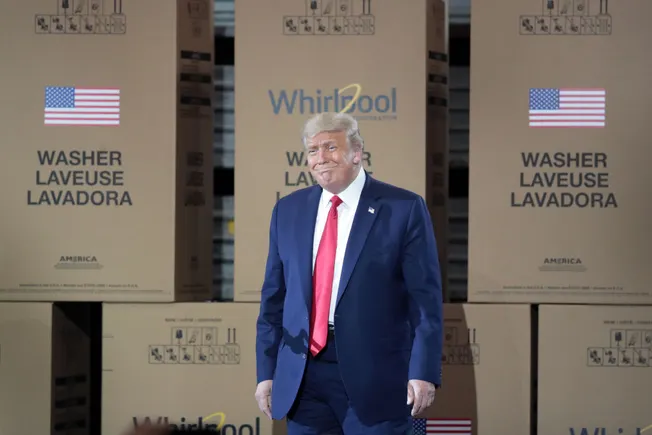
Over the past several months, President Donald Trump has repeatedly touted tariffs as an effective mechanism to drive widespread investment in U.S. manufacturing. In countless comments and posts, he has argued that such investments will lead to substantial job growth and bolster domestic technological capabilities. Even as economists warn of tariff-induced price increases for U.S. consumers, Trump has maintained that any short-term disruption will be outweighed by long-term economic and industrial gains.
"Tariffs are about making America rich again and making America great again, and it is happening, and it will happen rather quickly," the president said in a joint congressional address in March. "There will be a little disturbance, but we are OK with that."
As the list of levies imposed by the administration continues to expand, the manufacturing industry is bracing to see whether the president's theory about the power of tariffs will hold true.
Will tariffs really lead to widespread investment?
One of the president's frequent justifications for heightened tariffs is to incentivize manufacturers to invest in new or expanded facilities in the U.S., thereby avoiding higher import taxes. In recent weeks, major manufacturers like Hyundai and Taiwan Semiconductor Manufacturing Co. have lent support to that claim, announcing hundreds of billions of dollars in new manufacturing investments. While neither company explicitly tied its investments to the tariffs in its announcements, both unveiled plans from the White House. At the Hyundai rollout in March, Trump said the money was "a clear demonstration that tariffs very strongly work."
Across the wider industry, however, experts are more skeptical about whether smaller firms will take the same investment leap while trade policy remains fluid. The uncertainty around whether tariffs will remain at their current levels makes it more fraught for companies to invest in expensive facilities or supply chain overhauls, said Jeremy Tancredi, partner of operations excellence and supply chain management at West Monroe, during a recent Manufacturing Dive event.
Tancredi cautioned manufacturers against taking "drastic" measures to overhaul their supply chains until policies standardize and normalize, "and not making some of those decisions that may look good today under today's landscape, but as it changes tomorrow, next week, next month, it doesn't become as good a solution."
Treasury Secretary Scott Bessent has been a vocal supporter of the Trump tariffs, saying in an April 4 interview with investment bank Jefferies that the duties could raise between $300 billion and $600 billion in revenue per year and protect domestic industries from what the administration views as unfair global practices. In an interview on The Tucker Carlson Show earlier this month, Bessent described tariffs as the "beginning of a process" to reindustrialize the U.S. and push back against foreign economic systems like China's, which subsidizes industry.
"If we could put on a 20% tariff, have the foreigners pay that, and use that money to bring down our government deficit and keep taxes low? That's a very unique formula that hasn't been tried in this country for a long time," the secretary said.
The administration has particularly prioritized expanding domestic semiconductor production, using tariffs to incentivize TSMC and others to invest in the U.S. This policy stands in contrast to the Biden administration's direct funding approach through the landmark CHIPS and Science Act.

Gary Clyde Hufbauer, a nonresident senior fellow at the Peterson Institute for International Economics, remains skeptical that either Biden's or Trump's approach can significantly grow U.S. production for mature and legacy chips—the larger, foundational semiconductors that the country currently imports from countries such as Taiwan, China, or South Korea. "There will be some additional production," Hufbauer said. "I just am skeptical the U.S. can bring the cost down to the levels of South Korea, given the wage structure here and the fact that we don't have a history in those industries for a long time."
Hufbauer added that new semiconductor factories would take a minimum of two years to build and could still likely lead to more expensive products. While major firms like TSMC and Nvidia have made large-scale investment announcements, smaller manufacturers are less likely to do so while policy remains fluid. "While those are pretty stunning announcements that the big firms have made, all the uncertainty that comes with Trump's changing tariff initiatives, the U.S. as a whole has actually depressed manufacturing investment," Hufbauer said. "The uncertainty, for most firms, causes them to take a wait-and-see attitude." Even if Trump keeps tariffs in place throughout his presidency, Hufbauer added that "it's hard to say what the next administration will do, given the general unpopularity of the tariff."
Tariffs seek to turnaround a decades-long manufacturing decline
Looking beyond current tariff policies, Robert Lawrence, an international trade professor at Harvard University, said that a deeper underlying issue is that less economic growth in advanced economies is powered by manufacturing. Manufacturing's contribution to U.S. gross domestic product has been steadily declining over the past two decades. In 1997, manufacturing contributed 16% of U.S. GDP; by 2021, that number had fallen to 11%, according to the World Bank.
Manufacturing's contribution to the U.S. economy has fallen in recent decades
In Q3 2024, manufacturing contributed $2.93 trillion to the U.S. economy, roughly 10% of GDP, according to the National Institute of Standards and Technology. Multiple factors contribute to this decline, including that U.S. consumers today spend less of their income on finished goods compared to decades past, Lawrence said. "The combination of fast productivity growth, and what people who are richer do with their money, has meant that the share of manufacturing inevitably declines over time in advanced industrial economies," he added.
Increased global trade with countries where labor is cheaper, such as China, is often said to have contributed to a decline in U.S. manufacturing, as companies established production hubs abroad and consumers increasingly bought less expensive, foreign-made goods. Trump has also frequently blamed the North American Free Trade Agreement—which he renegotiated as the United States-Mexico-Canada Agreement in 2020—for the decline in domestic manufacturing, calling it "the worst trade deal probably ever made."
Are more manufacturing jobs the win Trump claims?
The president has also been vocal in his assertion that tariffs will drive not only increased investment but also job growth. While the U.S. did add 228,000 jobs in March, up from a revised 117,000 job increase in February, those numbers were recorded before Trump's broad-based tariffs took effect in April. In the manufacturing industry, job growth remained relatively flat last month, adding only 1,000 jobs, according to the Bureau of Labor Statistics.
It remains to be seen whether manufacturers will substantially increase hiring as a result of tariffs. Large-scale investments like TSMC's are said to come with the creation of thousands of jobs. At the same time, however, observers say unemployment overall could reach up to 4.7% by year's end, up from the current level of 4.2%, according to a CNBC report.
Further complicating the issue is that, much like the size of the manufacturing economy, industry jobs have dropped steadily over the past several decades. Manufacturing employment has fallen from a high of more than 19 million jobs in 1979 to nearly 12.8 million in March 2025. Fewer manufacturing jobs are needed today to produce the same amount of output, making the scale of success smaller, Lawrence said. "If we were to eliminate the trade deficit by producing all those goods in the US, it would increase manufacturing employment by one to two percentage points. That's what success looks like," he noted.
Economic policies need to adapt to meet the current state of demand, Lawrence said, rather than focus solely on trade. "If you want to come up with solutions that really deal with the problems, and they are serious, of what people without college educations are earning and what left behind places that have lost manufacturing plants are doing, if you want to help them, you have to have policies specifically designed to meet the demand in the economy that is coming internally, rather than through international trade."