
How drone delivery companies can cross the scale threshold and achieve ambitious goals
Zipline and Alphabet's Wing, two giants in the drone delivery field, released major service upgrades earlier this month aimed at expanding delivery scale. However, experts say that to achieve these ambitious goals, companies not only need substantial investment but also must optimize operational efficiency, overcome regulatory restrictions, and win public trust.
Earlier this month, two giants in the drone delivery field—Zipline and Alphabet's Wing—announced major service capability upgrades aimed at reshaping the last-mile delivery landscape. Although their upgrade paths differ, the goal is the same: to scale up and reach more customers. Wing expects its drone delivery network to handlemillions of deliveriesby mid-2024; Zipline plans to achievemore flight volume than most airlines annually。
by 2025. However, achieving these goals requires more than just substantial investment—Amazon's experience serves as a cautionary tale. Amazon has reportedly encounteredsafety challengesandlimited delivery operationsin its drone delivery efforts. Companies need to maximize network efficiency to reduce operating costs while gaining support from regulators and consumers to fulfill the promise of drone technology. Otherwise, experts point out, it will take longer for drones to become as common as delivery vans.
Increasing density and adjusting regulations to lower costs
In the last-mile delivery sector, operators are working to increase delivery density, such as having couriers complete as many deliveries as possible on a single route, to reduce operating costs. Although drones are typically limited to lightweight payloads, networks can create their own 'density' by ensuring the fleet operates continuously—performing pickups and deliveries as frequently as possible to sustain the business model.
'The worst case is having vehicles (whether drones or trucks) sit idle,' said James Campbell, professor of supply chain and analytics at the University of Missouri-St. Louis. 'The most sensible approach is to achieve massive scale, keeping drones flying constantly, thereby spreading facility fixed costs across many drones and many deliveries.'
While delivery density is a key factor, it is only one way to reduce operating costs. Eric Peck, CEO of drone logistics platform Swoop Aero, said in an email that designing faster drones can respond to demand more quickly, providing more valuable service to customers, which translates into more substantial profits. Expanding delivery range also helps unlock new business lines, such as maritime logistics.
Peck also noted that one pilot monitoring multiple aircraft will help operators maximize returns on network investment. A McKinseyreportpublished in January 2022 supports this view, stating that under current pilot restrictions, drone delivery struggles to compete with other last-mile transportation methods in operating costs. The report shows that with one person monitoring one drone, the cost per package delivery is about $13.50; if one operator can manage 20 drones simultaneously, the cost per delivery drops sharply to about $1.80.
Efficient operations have the greatest impact on drone costs
In the U.S.,a waiver is requiredto operate multiple small drones with one remote pilot, and operators also need certification to conduct drone deliveries beyond the visual line of sight of the pilot or observer.
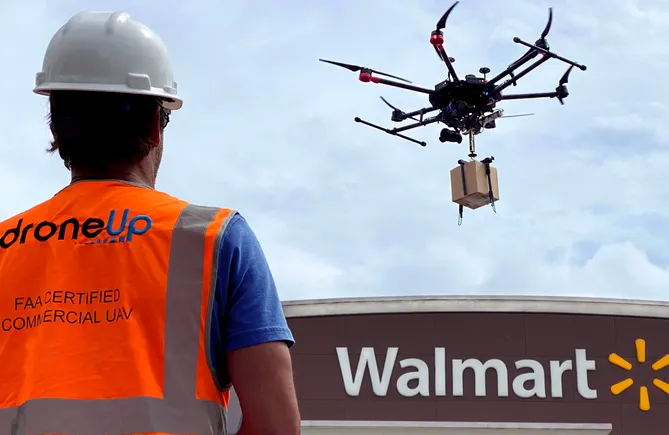
For DroneUp, which helps Walmart achievea million drone deliveries per yearthe visual line-of-sight restriction limits its delivery radius to about two miles. Expanding this range would bring significant benefits—DroneUp Chief Operating Officer Anthony Vittone noted that 90% of the U.S. population lives within ten miles of a Walmart. 'For every additional mile of delivery radius, the number of reachable households increases three or even four times,' he said.
Consumer acceptance and habits need to evolve in tandem
As delivery activities increase, companies also need to address concerns within the communities they operate in. Vittone said some potential customers have an unknown fear of drone delivery, which is common with emerging technologies. To reduce uncertainty, employees answer public questions at Walmart stores and conduct demonstrations.
Drone companies also need to consider the potential disruption their operations may cause to the public. For example, Wing has facednoise complaintsin Australia. In an email to Supply Chain Dive, the company said that engaging with communities, answering questions, and gathering feedback before launching new services is a top priority.
'The reality is that drone delivery brings significant benefits—reduced traffic congestion, lower emissions, expanded business opportunities, and enhanced consumer convenience—which become apparent once drone delivery is implemented,' Wing said.
If companies can gain public support, the prospect of drones disrupting traditional last-mile operations is clear. Their speed advantage is obvious, bypassing ground traffic to reach customers directly. But Campbell questions what items, besides food and emergency medicine, need to be delivered within 15 to 30 minutes—consumer behavior may need to shift, similar to changes that occurred when FedEx introduced express delivery or Amazon accelerated online order shipping.
For drone delivery companies to reach disruptive heights, they must first significantly expand their coverage and capabilities. Given recent announcements, that moment may come sooner than expected. 'Things in this field rarely happen before someone predicts them, but I am much more optimistic than in the past that this day will come,' Campbell said.
Editor's note: This article first appeared in our Logistics Weekly newsletter. Pleasesubscribe here。