
2025 Logistics Risk Outlook: Tariffs and Labor Disputes as Key Variables
2025 logistics industry risk checklist: tariff policies, labor negotiations, capacity bottlenecks, and freight rate volatility intertwined. From ILA-USMX contract approval to Canada Post strike threats, all transportation modes are under pressure. Experts advise shippers to prepare data in advance, diversify channels, and secure capacity.
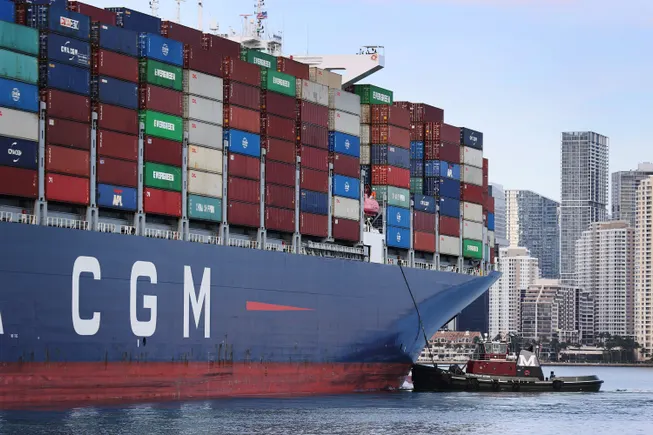
The new year will bring a series of challenges to shippers' logistics strategies.
President-elect Donald Trump's push for higher tariffs, potential labor disruptions, and pricing pressures are variables supply chain managers must navigate in 2025. Carriers across ocean, air, rail, trucking, and parcel delivery are not spared, each facing complex situations.
Supply Chain Dive spoke with several experts about logistics risks in 2025 and how shippers can respond. Here are the key takeaways.
ILA-USMX contract ratification and tariff shadows loom over ocean shipping
The ratification process for a six-year tentative union contract for dockworkers at U.S. East and Gulf Coast ports will be a key focus for ocean shippers.
The agreement announced last week by the International Longshoremen's Association (ILA) and the United States Maritime Alliance (USMX) averted a potential port strike on January 15. However, the deal still requires approval from rank-and-file workers and port employers to take effect, and the supply chain sector has seen contracts rejected before.
Brian Pacula, supply chain partner at West Monroe, told Supply Chain Dive in an email that if the strike threat resurfaces, companies can prepare by closely monitoring cargo moving through affected ports, balancing existing inventory levels, and exploring West Coast alternatives. He added that shippers could also turn to air freight if willing to bear additional costs.
Pacula noted that beyond contingency planning for port disruptions, shippers should also consider how Trump's proposed tariffs, if implemented, would impact ocean shipping routes. Some companies are importing early and building up inventory ahead of Trump's return to the White House to minimize the impact of new tariffs on profits.
"At a minimum, supply chain teams should gather and organize relevant data sets, explore alternative options, and develop a shortlist of strategies to assess impacts on cost, lead time, and suppliers." — Brian Pacula
Mexico demand could trigger rail capacity bottlenecks
Labor disputes and tariffs could also affect rail shippers' strategies in 2025. Jay Cushing, senior credit analyst at bond research firm Gimme Credit, said companies may release some rail volume early to reduce overall logistics risk exposure.
Cushing said: "For railroads, customers, and investors, we believe intermittent labor disruptions and tariff uncertainty should be viewed as operating 'costs'—not one-time items."
Cushing noted that CPKC Railway, due to its network connecting the U.S., Canada, and Mexico, is particularly vulnerable to Trump's potential tariffs on North America. But he added that as supply chain nearshoring continues, CPKC could also benefit from growth in cross-border freight between the U.S. and Mexico.
"Capacity has not kept pace with growing demand."

Paul Brashier
Vice President of Global Supply Chain at ITS Logistics, commenting on outbound rail activity from Mexico
Rising trade activity between the U.S. and Mexico is at times straining available rail capacity and disrupting trade flows. Agriculture felt the pressure last year when major U.S. railroads suspended grain shipments to Mexico. Outbound rail activity faces similar conditions.
Paul Brashier, Vice President of Global Supply Chain at ITS Logistics, said: "Over the past 18 months, outbound demand from Mexico has grown significantly, and capacity has not kept pace with demand." He added that Mexico needs to strengthen infrastructure to handle higher activity levels. According to ProTrans, a transportation and supply chain management services provider, rail transport is a key part of Mexican President Claudia Sheinbaum's infrastructure improvement plan.
ProTrans said: "Mexico's infrastructure is improving, but it still faces numerous demands and challenges that have created the current gaps and are driving new investment needs."

Uncertainty over low-value import duty exemption looms over air cargo
Madhav Kurup, Chief Operating Officer for Air, Ocean, and Contract Logistics at Hellmann Worldwide Logistics, believes regulatory uncertainty and tariff risks for low-value imports are two potential headwinds for air cargo in 2025.
The de minimis duty exemption, which allows companies to avoid paying tariffs and taxes on U.S. imports valued under $800, has come under increased scrutiny in recent years. U.S. Customs and Border Protection announced Monday plans to strengthen data collection requirements for these imports. The policy has been a key tool for the direct-to-consumer supply chain, and e-commerce volumes leveraging de minimis have helped drive the air cargo industry's recovery.
Kurup said in an email: "Any policy change could affect e-commerce flows, which in turn could impact the air cargo industry. Although the industry has shown resilience amid geopolitical and economic changes, navigating these challenges will still require flexibility and strategic planning."
Meanwhile, Judah Levine, Head of Research at Freightos, said in a November email that air cargo demand could briefly rise before new tariffs take effect. He explained that if importers cannot secure all needed inventory via ocean freight before tariffs are implemented, they may temporarily increase air freight usage to lock in goods and avoid higher customs costs.
But overall, Levine said shippers have had ample time to advance inventory ahead of the next Trump administration, which provides a short-term boost to ocean activity rather than air freight.
He said: "Because tariffs are expected to be imposed by the new Trump administration at some point in 2025, many shippers have already begun increasing ocean volumes, as there could be at least several months before any changes actually take effect."

Truckload rates may no longer be shipper-friendly
Chris Caplice, Chief Scientist at DAT Freight and Analytics, says 2025 is unlikely to continue the soft rate environment of the past two years for full truckload shippers.
Caplice said in an email that since spring 2022, average contract rates for long-haul dry van trailers have fallen 23%, and spot rates have fallen 36%. But signals in the second half of 2024 suggest pricing power may soon shift back toward carriers.
Because this shift could push costs higher, supply chain professionals need to clearly communicate expectations for truckload rates this year to executives. Caplice said: "If your executive team believes 2025 tenders will still deliver year-over-year savings, it might be worth showing them an analysis of truckload pricing over roughly the decade before the pandemic. Comparing rates to broader market benchmarks is far better for measuring performance than year-over-year comparisons."
Jeremy Nolt, Vice President of Brokerage at Zipline Logistics, says current truckload rates are low, and shippers are trying to lock in longer contract terms than usual.
Nolt said in an interview: "Clients are hedging their bets, saying 'I'm not sure if things will improve, rates may not stay low for long, so let's lock in rates with brokerage partners at current levels as much as possible.'"
Parcel delivery business faces strike risks
Further downstream, several parcel carriers face potential labor disruptions this year.
Amazon warehouse workers and contract delivery drivers organized by the Teamsters union went on strike during the peak holiday season in December. Although the strike has ended, a union spokesperson told Supply Chain Dive in December that its efforts to unionize Amazon workers are not over.
Meanwhile, FedEx has yet to reach a new contract with its pilots' union after employees rejected a tentative agreement in 2023. The union sought to exit regulated negotiations last year to speed up the process, but federal mediators denied the request. Exiting is a necessary step before pilots can strike.
Perhaps the biggest threat to parcel delivery reliability in 2025, at least in North America, is another strike at Canada Post if union contract negotiations break down.
Last year, employees brought the state-owned carrier to a standstill for over a month until the Canada Industrial Relations Board ordered a return to work, with operations resuming on December 17. The board's action bought Canada Post time to reach an agreement with the Canadian Union of Postal Workers by May 22, the revised contract expiration date.
If no agreement is reached by then, Canada Post customers could face more delays, prompting shippers to further diversify among alternative carriers. However, Alison Layfield, Director of Product Development at ePost Global, said in an interview during the December strike that other delivery services often rely on Canada Post for deliveries to remote addresses.
Layfield said: "There are too many remote areas that only Canada Post can reach. Carriers like UPS and Purolator have contracts with Canada Post in those specific areas, so they have no one else to hand off to either."
Larry Avila, Colin Campbell, Alejandra Carranza, and Kelly Stroh contributed to this report.