
FedEx braces for network overhaul as USPS contract winds down
FedEx's air cargo network faces major restructuring after its U.S. Postal Service contract expires Sept. 30, with UPS taking over as primary air cargo provider. Analysts project potential cuts of 50% in daytime flight capacity and $1.5 billion in savings, while FedEx's DRIVE program and parked aircraft signal aggressive cost-reduction efforts.
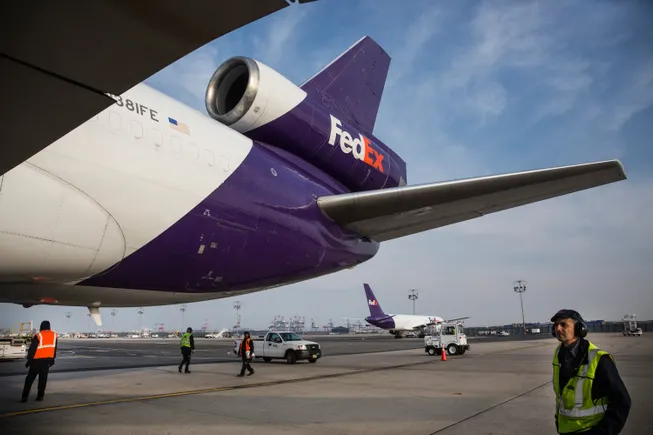
FedEx's air cargo network may look substantially different starting in October, as its Express unit prepares to operate without the U.S. Postal Service as one of its largest customers.
Rival UPS will assume the role of the Postal Service's primary air cargo transportation provider under a contract being implemented Sept. 30 — the day after the agency's existing agreement with FedEx for airport-to-airport shipping expires. FedEx said in a statement it will make adjustments to its network once the contract ends, including cutting structural costs currently in place to support the Postal Service's volume.
One likely target in those adjustments is daytime flights, which the Postal Service frequently uses. Barclays analysts said in a February research note that FedEx could cut 50% of its daytime flight capacity and save $1.5 billion without the contract in place.
Reaching that figure will depend on how much capacity FedEx is willing to shed. Experts told Supply Chain Dive that the company won't hesitate to implement changes quickly when the deal ends, given its aggressive approach to cost-savings in recent quarters.
"I think FedEx knew they were going to walk away from the business with the USPS, and I think what they want to do in terms of reorganizing air operations and shrinking the footprint of it is already in the books," said Dean Maciuba, managing partner, United States, for Crossroads Parcel Consulting. "They'll be able to implement these changes really, really quickly."
FedEx's large air network keeps evolving
FedEx is a giant in the air cargo space. It outranks UPS in terms of fleet size, daily departures and capacity, and it also generates more global air freight revenue than UPS, the Barclays analysts wrote. The Postal Service contract has been a key piece of that success, as FedEx counted the agency as its largest Express customer as of May 31, 2023.
However, FedEx's airline is also much more expensive to maintain and operate compared with its rival. Daytime domestic U.S. flight operations, driven primarily by the Postal Service business, cost FedEx roughly $3 billion annually, according to the Barclays analysts. Meanwhile, FedEx's revenue has been pressured by reduced Postal Service activity in recent quarters, as the agency leans more on ground transportation to move volume.
"It's much smaller than what it used to be, and much smaller than what they may have already built the capability to support years ago," Pandion founder and CEO Scott Ruffin, who previously founded and led Amazon Air, said of FedEx's Postal Service business.
By the numbers
- 499 — FedEx Express' daily flight departures for its domestic U.S. operations, 93 more than UPS, according to Barclays research
- 90-100 — The estimated number of flights FedEx Express operates in its daytime network to service the Postal Service contract
- ~50% — The amount of FedEx Express daytime network capacity USPS is projected to use historically
- $3 billion — Barclays' estimated annual cost of FedEx Express daytime flight operations
- $1.6 billion — The amount the Postal Service spent on FedEx services in FY2023, down from $1.9 billion the year prior, Culhane Meadows partner David Hendel told Supply Chain Dive
FedEx hasn't been hesitant to implement large-scale changes to improve its bottom line in recent quarters, particularly when it comes to cutting costs in its expensive air transportation network. Through its wide-ranging DRIVE program, FedEx is reducing routes and more efficiently deploying crews and other resources.
For the quarter that ended Feb. 29, FedEx saw $110 million worth of air network savings as a result of DRIVE. The company also has 37 jet aircraft parked, up from 20 the previous quarter.
"It is my top priority to continue to make the changes necessary to align our air network with an evolving demand environment and unlock the full profit opportunity," President and CEO Raj Subramaniam said in a March earnings call.
Daytime flights, pilot ranks seen as targets
The largest piece of the contract involves FedEx moving the Postal Service's Priority Mail shipments through a daytime hub, spoke and sorting operation centered around its Memphis, Tennessee, hub, the Barclays analysts said.
Consequently, daytime flights will be a prime target for reductions as a result of the contract loss, according to industry experts. Even when FedEx was in negotiations for a new Postal Service contract, the company had been pushing for a deal involving service to fewer markets.
"A lot of things are going to impact pilots' lives going forward on this."
— Marty Harrington, scheduling committee chair for FedEx's pilots union, on the loss of the U.S. Postal Service contract
Non-Postal Service volume affected by any daytime flight reductions may be ferried via ground transportation to another air cargo gateway, said Derek Lossing, a former Amazon Logistics leader who is now the founder and principal advisor of Cirrus Global Advisors.
"The last thing they want to do is go to large retailers and say, 'We want less second-day air [volume],'" Lossing said. "They're gonna say, 'That second-day air that you give to us in New Jersey, that's going to go on a three-hour linehaul to Philadelphia before it flies to Minneapolis.' It's just a little bit different connectivity in their network."
Marty Harrington, scheduling committee chair for FedEx's pilots union, also views daytime flight capacity as a target for reductions. He said on a union podcast earlier this month that he expects it will be "reduced quite dramatically starting in October."
FedEx's "overstaffed" pilot ranks are likely to be thinned by the contract's expiration as well, but the precise impact will be unclear until post-contract flight schedules and associated staffing needs are finalized, he added.
"I know it's very difficult, but we're going to have to be patient," Harrington said. "A lot of things are going to impact pilots' lives going forward on this."
