
Ocean Freight Rates Surge: Unpacking the Factors Behind the Recent Spike
Ocean freight rates have more than doubled since January, driven by the Red Sea crisis, longer transit times, and port congestion. Industry experts explain the dynamics and offer advice for shippers facing elevated costs.
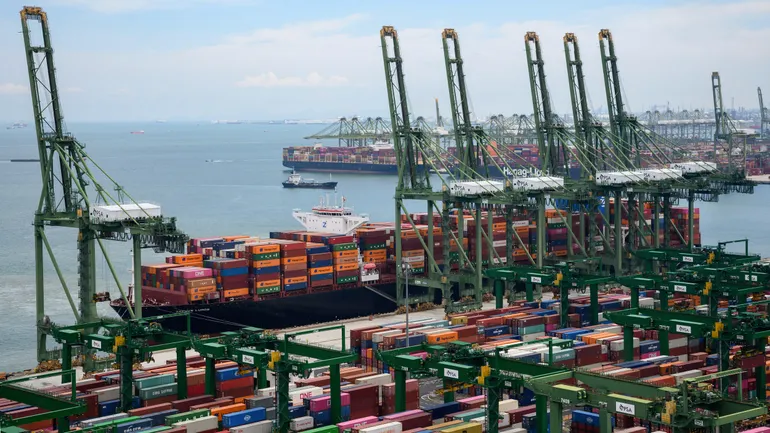
The Red Sea crisis is roiling ocean freight markets, leading to a surge in shipping costs that is putting pressure on shippers worldwide. Several months after the initial vessel attacks along the Red Sea prompted widespread diversions, the ripple effects continue to disrupt global supply chains.
These diversions have extended vessel transit times, contributing to congestion at major ports and tightening capacity. According to a July 2 update from Freightos, spot rates from Asia to the U.S. West Coast reached $7,052 per forty-foot equivalent unit (FEU), while rates to the U.S. East Coast climbed to $8,253 per FEU. Although these figures are below the pandemic-era peaks of over $10,000 per FEU, they reflect a market under significant strain.
Longer Transit Times Drive Up Costs
The Suez Canal, traditionally a fast and reliable artery for Asia-Europe trade, has become a high-risk zone due to the threat of vessel attacks. Many shipping lines have rerouted services around the Cape of Good Hope in South Africa, adding two to three weeks of travel time in each direction, depending on the destination in Europe and Asia, according to Goetz Alebrand, head of ocean freight at DHL Global Forwarding in the Americas.
Longer voyages translate into higher fuel and operating expenses for carriers, which are passed on to shippers through rate increases and surcharges. Carriers began announcing a series of surcharges shortly after the attacks started, and these costs have compounded with typical peak season rate hikes and other supply-demand dynamics.
“Today, all ships that can sail and all ships that were previously not well utilised in other parts of the world have been redeployed to try to plug holes,” said Vincent Clerc, CEO of A.P. Moller — Maersk, in a July 2 market update. However, he cautioned that redeployment is not a complete solution. With high demand and reduced vessel capacity, Maersk expects to utilize ships of varying sizes in the coming month, which will limit its ability to carry expected demand.
The World Shipping Council acknowledged in a statement to Supply Chain Dive that the Red Sea crisis has added transit times and millions of dollars in costs. The trade association also noted that spot rates are influenced by other factors, including Panama Canal capacity and global energy policy. “Regarding spot-market rates specifically, it’s important to note that the large majority of global container traffic generally moves under rates that have been negotiated through long-term contracts,” the council said.
Congestion Compounds the Problem
The supply-demand imbalance is causing congestion at ports in Southeast Asia and the Mediterranean, according to several sources. In Asia, waiting times of up to seven days have been observed in Singapore, the world's largest transhipment port, and more than three days in Manila, said Marcus Reimann, SVP of sea logistics for the Americas and Asia Pacific at Kuehne+Nagel, in a July email. In the Mediterranean, wait times for vessels to berth have surpassed three days at the Port of Barcelona and two days in Casablanca.
Trans-shipment ports play a pivotal role in the maritime supply chain, serving as hubs for carriers to reconfigure cargo between ships. When a vessel misses its estimated time of arrival, it can trigger cascading delays for other vessels, as equipment may be missing or unavailable.
Reimann told Supply Chain Dive in May that the delays have a trickle-down effect on global markets. “We assume that five to 10% of capacity is absorbed by the longer transit times — capacity in vessels and capacity in equipment — and then of course it [has an] impact on everything else,” he said.
To manage congestion and delays, some carriers have increased their use of blank sailings—skipping ports or canceling routes. Sea-Intelligence noted in a May press release that “with virtually no idle vessels, and with spot rates increasing sharply in recent weeks, this increase in blank sailings is driven by the Red Sea crisis. Port congestion is worsening in key hubs in both Asia and Europe. And as was clearly seen during the pandemic, port congestion soaks up supply and leads to potential capacity shortages.”
According to a June 28 analysis by Drewry Supply Chain Advisors, canceled sailings over the next few weeks are concentrated in a few trade lanes. Of the 53 canceled sailings tracked in major East-West shipping lanes, more than half are occurring in Transpacific Eastbound services.
The rise in blank sailings underscores the tight supply conditions carriers face. With peak season approaching in the U.S., demand for vessel space exceeds available capacity, driving rates higher. “As long as there is a strong demand that is not supported by enough capacity rates will stay elevated and further increases are expected on specific trades in relation to that supply and demand equation,” Alebrand said.
Strategies for Shippers
Despite the challenging market, experts emphasize that shippers have tools to mitigate the impact of high costs. Alebrand advised shippers to increase visibility and forecasting to plan volume and costs effectively. “It is prudent to budget for volatility and be ready for short-term cost increases when cargo has to ship,” he added.
Reimann stressed the importance of predictability. Shippers should try to secure forecasts for the next few months, as the unstable market could persist beyond the peak season. Above all, he advised avoiding shipping over weekly allocations, as that is likely to lead to higher rates.
Brian Bourke, global chief commercial officer at Seko Logistics, recommended that shippers communicate ocean container forecasts early and often, and make bold decisions now. “We don’t anticipate capacity improving any better until the end of 2024 and perhaps beyond due to a number of factors,” he said in an email. “This situation can be compared to trying to get an Uber at rush hour or during a holiday – riders experience a surge in pricing when demand is high.”
Edwin Lopez contributed to this story.

