
Inside Amazon's Automated Warehouse in Washington State
Amazon's BFI4 fulfillment center, located in Kent, Washington, has been operational since 2016 and is the first facility in Amazon's network with a daily processing capacity exceeding one million items. The center combines about 3,500 employees with automated robotic technology to achieve efficient storage, picking, and packing of goods. A reporter's on-site visit reveals how its semi-automated workstations, Hercules robots, and intelligent packaging systems work together.
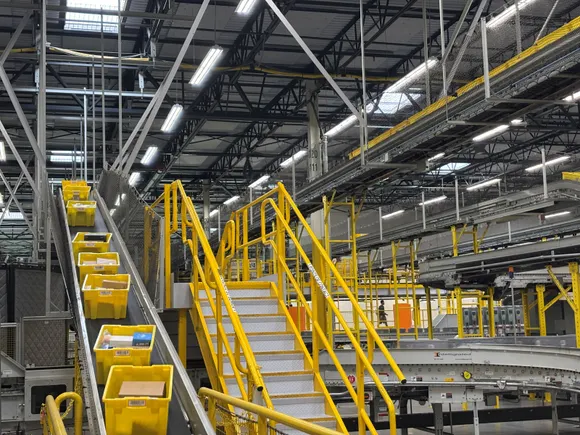
Every day, millions of packages flow through Amazon's ever-expanding network of fulfillment centers, with an increasing number of steps being automated to boost efficiency.
Located in Kent, Washington, the BFI4 fulfillment center is the first facility in Amazon's network with a daily processing capacity exceeding one million packages. The center combines the skills of about 3,500 employees with robotics, enhanced workstations, inventory pods, and automated packaging equipment to ensure efficient package flow.
A reporter donned steel-toe shoe covers to get a behind-the-scenes look at the full operations of this warehouse. Here's what the on-site visit revealed:
Welcome to BFI4

BFI4 first opened in 2016 and is the first facility in Amazon's network with a daily processing capacity exceeding one million items. To handle such a massive volume, the center combines about 3,500 employees with automation and robotics to store, pick, and pack items.
Items arrive at BFI4

Packages first arrive at the facility via trucks, and employees then unload them onto conveyor belts for transfer and storage in the inventory area. Storage operations take place at the Universal Station, which is manually operated by employees. At the Universal Station, totes containing items are delivered to the workbench, and employees place the items onto corresponding inventory shelves, known as pods. Order picking is also completed at these stations.
Semi-automated workstation operations

In traditional warehouses, employees typically walk to shelves to pick or store items. At BFI4, inventory pods spanning four floors are transported byHercules robotsto Amazon Robotics Semi-Automated Workstations or Universal Stations.
To fulfill customer orders, employees pick items from inventory pods at ARSAW stations. These stations are used only for the picking process, placing selected items into containers called totes.
Projector lights highlight specific areas of the pod to visually guide employees in accurately picking items. Employees then place the picked items into totes.
Hercules robots transport inventory

Inventory pods and Hercules robots are confined to a dedicated fenced area of the warehouse, adjacent to the ARSAW and Universal Stations. In this area, Amnesty Floor Monitors are crucial for troubleshooting, such as restarting mobile robots or clearing obstacles from the active floor.
Items move to the packaging department

From a macro perspective, after employees complete picking, items are sorted into trays or totes and routed to the appropriate packaging workstation based on order type. Single-item orders and multi-item orders follow automated paths into different areas of the packaging process.
Packaging process

Different packaging areas also utilize automation technology.
For example, the CW1000 packaging machine uses advanced sensors to measure each item and precisely apply the protective packaging materials needed during shipping. This helps eliminate over-packaging that can occur with manual boxing.
The facility also has manual packaging stations where automated processes assist human operations. Multi-item orders enter the Amazon Fulfillment Engine area, where employees consolidate and pack items. In this area, the system guides employees in selecting the appropriate box size and is equipped with automatic tape dispensers.
Orders prepared for delivery

Employees then transport packed items to the shipping dock area. Packages are loaded onto trailers and sent to sortation centers (responsible for downstream transportation scheduling) or delivery stations (responsible for delivering packages to customers' doorsteps).
This article first appeared in our Operations Weekly newsletter.Click here to subscribe。