
Trump Announces 50% Tariffs on Canadian Vehicles, Auto Parts, and Steel
U.S. President Donald Trump announced a new round of tariffs on Canadian imports, including a 50% levy on cars, trucks, auto parts, and steel, set to take effect Jan. 1. The announcement follows the collapse of trade negotiations last week, with Canada vowing retaliatory measures.
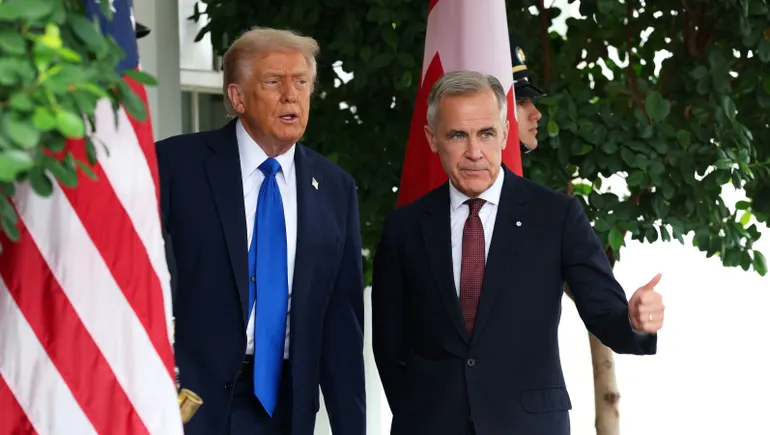
The ongoing trade friction between the United States and Canada has intensified, as U.S. President Donald Trump unveiled a fresh set of tariffs on Monday. In a social media post, Trump stated he would impose a 50% tariff on all cars, trucks, automotive parts, and steel imported from Canada, effective Jan. 1, alleging that Canada was “ripping off” the U.S.
The precise interaction between these threatened duties and existing Section 232 levies on imported automobiles and parts, as well as the United States-Mexico-Canada Agreement (USMCA), remains unclear. The White House has not yet published an official tariff order beyond the president’s social media statement.
This latest escalation follows the breakdown of trade negotiations last week over separate 50% tariffs that Trump had threatened more than a month ago. Those duties, initially ordered to take effect Wednesday, were delayed by three days as both countries sought a deal to avert them. However, on Friday, Canadian Prime Minister Mark Carney suspended trade discussions just hours before the implementation deadline, allowing the tariffs—targeting $20 billion worth of Canadian goods—to go into effect.
In a speech Saturday, Carney explained the decision: “While we believed, earlier this week, that we were moving toward a mutually beneficial agreement, in recent days, the U.S. proposed new terms that were uneconomic, unfair, and undermined the net benefits to Canada, calling into question the reliability of any deal. In short, they asked too much and offered too little.”
Carney has vowed to match the new duties “dollar for dollar” by Sept. 8, with retaliatory levies specifically targeting sectors including steel, dairy, appliances, agricultural equipment, pulp and paper, and electronics. “This is a focused response to protect and defend our industries and allow them to compete with U.S. products in the Canadian market,” he said Saturday.
The U.S., meanwhile, has placed the blame for the stalled negotiations on Canada. U.S. Trade Representative Jamieson Greer, in an interview with CNBC Monday, said the U.S. had offered to cut tariffs on Canadian steel and aluminum in half and to lower levies on automobiles and lumber. “They wanted more,” Greer said, indicating that the two countries had been close to finalizing a deal Friday before Canada broke off discussions.
Trade relations between the U.S. and Canada have been strained for over a year. In response to sweeping levies implemented by Trump in 2025, Canada imposed its own retaliatory tariffs on nearly $60 billion worth of U.S. goods, though it later rescinded some of those duties. Beyond tariffs, Canada has also imposed quotas on automotives and certain food imports, while several provinces have halted the purchase, distribution, and sale of U.S.-made alcohol.
In parallel, the two countries, along with Mexico, are currently undertaking what could be an up-to-10-year review of the USMCA, the trilateral trade pact governing commerce among the three nations. The review timeline was extended last month when the U.S. declined to fast-track an extension without further negotiations. Since then, Canada and the U.S. have made little progress, while Mexico and the U.S. have already held formal bilateral discussions, with additional meetings scheduled for next month.
Editor's note: This is a developing story and may be updated with more information.