
Sidewalk Delivery Robots: How Far Are We from Large-Scale Deployment After FedEx and Amazon Stumbled?
FedEx and Amazon have successively terminated their sidewalk delivery robot projects, raising questions about the feasibility of large-scale deployment. However, industry respondents believe that labor shortages and inflation could act as catalysts for the industry, though challenges such as funding and scenario diversification remain to be addressed.
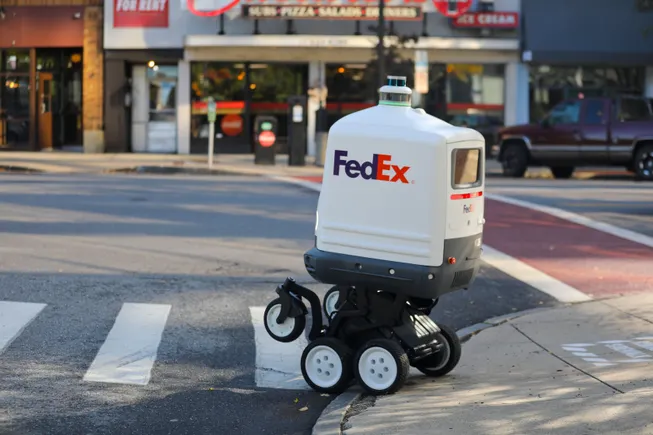
In 2019, a prototype robot from FedEx appeared on the American late-night talk show "The Tonight Show," where host Jimmy Fallon took a pizza delivered by the robot and said, "This is the future." The robot was later named Roxo, but according to a FedEx statement in October 2023, Roxo was discontinued less than four years after its debut. Meanwhile, Amazon also ended field tests of its delivery robot Scout because it failed to meet customer needs.
If logistics giants struggle to make the business model of sidewalk delivery robots work, can this field still achieve long-term sustainable development? Multiple executives, researchers, and regulators interviewed by Supply Chain Dive said "yes," and believe that current labor and inflation challenges may accelerate this process. However, they also noted that to achieve true success, the industry still needs to address major obstacles such as funding and scenario diversification.
Why delivery robots may accelerate in the post-pandemic era
Despite FedEx and Amazon exiting, the delivery robot field still has mature and growing players. Executives from these tech companies say that compared to human couriers driving vehicles, using robots for delivery has shown more obvious advantages in recent years.
The most critical is reducing the cost of "last-mile" delivery—considered the most expensive part of the entire transportation process. With autonomous or remote operation capabilities, delivery robots are not directly affected by rising courier wages, which are often passed on to end customers. Additionally, robots are less vulnerable to last year's oil price surge, which put pressure on carriers and their shippers.
"After the pandemic, there was a labor shortage," said Ali Kashani, co-founder and CEO of Serve Robotics, a delivery robot developer and operator. "Then inflation and labor costs rose, and oil prices also went up. These factors have all become tailwinds for us."
Although sidewalk robots cannot match fuel-powered vehicles in range and payload, they are well-suited for handling immediate small-item delivery needs from nearby merchants. Therefore, many robot companies are expanding their business by focusing on food and convenience goods delivery. Serve's robots have completed orders for Los Angeles customers on the Uber Eats platform, and 7-Eleven recently partnered with the company for a test in West Hollywood, California. Food delivery services have also proliferated on university campuses, with Grubhub partnering with tech companies like Kiwibot and Cartken to provide robot delivery services on campus.
The question is whether this market is large enough for these companies to grow into self-sustaining businesses.
Zach Rash, co-founder and CEO of Coco, said food is the most reasonable initial category for delivery robots because it has high frequency, strong local demand, and fast delivery requirements. But he also noted that in the long term, to maximize robot utilization, expansion into other categories is necessary. "You need a lot of scale and density," Rash said of the long-term success formula in the delivery robot field. "Food is the best way for us to achieve that while ensuring profitability along the way."

Although robots will not become a universal solution for "last-mile" delivery, executives believe more applications may be seen in other areas. For example, Starship Technologies' robots primarily deliver spare parts, testing supplies, and samples within industrial parks in Germany. Starship CEO Alastair Westgarth said future industry players may work in coordination with vans and trucks. "We are adding a new way to delivery, not taking over the entire delivery world," he said.
Complex challenges conflict with immediate needs
Cartken CEO Christian Bersch acknowledged that the volume of deliveries completed by autonomous vehicles is currently "almost negligible." To take share from traditional transportation methods, robot companies need funding to expand their service areas, improve existing technology, and ultimately offer lower costs than competitors.
But executives say economic uncertainty has tightened the pool of funds from venture capital and private equity. Starship, a major player in the robot field, cut staff and service areas last year when the funding environment deteriorated. Westgarth said: "We want to ensure we adapt to this dynamic and focus on making the company viable in the long term. One could say we prioritize further improving unit economics."

Although large diversified companies may have the financial resources to expand their own robot programs, success requires patience because barriers to adoption, infrastructure, and regulation remain significant. This includes current battery life limitations of robots, which means covering new customers in suburbs and exurbs will be difficult. Starship's Westgarth said cities and universities account for 90% of the company's business, with cities making up the majority.
Long-term challenges may conflict with near-term needs, as seen with FedEx. In its October statement, the company said it discontinued Roxo to "prioritize several more near-term opportunities" as overall service demand was slowing.
Pure robot delivery companies cannot simply "cut losses" easily; they still need to grow at a pace that meets investor expectations. Many executives say they are cautious about overly aggressive expansion lacking community support, fearing a repeat of the backlash electric scooters faced years ago. Bern Grush, executive director of the Urban Robotics Foundation, disagrees.
"Do you want to tell investors 'we don't want to own 20,000 robots'?" Grush said, whose foundation helps member cities coordinate robot-related policies. "Do you want to tell investors 'we are satisfied with 12 robots'? ... The entire industry needs to deliver one million items per hour."
Editor's note: This article was first published in our Logistics Weekly newsletter. Click hereto subscribe。