
Logistics companies race to adjust layouts in response to global supply chain restructuring
Global supply chains are undergoing profound transformation, with manufacturers investing in new plants in regions closer to consumers or with lower risks to enhance resilience. Logistics companies are following the flow of capital, striving to gain an edge amid the geographic shift in demand by expanding cross-border services, opening new routes, and investing in key markets. This article reviews the latest developments in maritime, air, and multimodal transport.
Editor's note: This is the first article in a series exploring changes in the global trade landscape.
How can logistics companies respond to the profound transformation of global supply chains? The answer may be glimpsed by following the flow of capital.
After years of political and pandemic-related disruptions, manufacturers are investing billions of dollars to build factories in regionscloser to consumersorlower-risk alternatives to Chinato enhance supply chain resilience. These trends—known as "reshoring," "nearshoring," and "friendshoring"—may increase shipper costs in the short term, but Brian Bourke, global chief commercial officer at SEKO Logistics, said at a media event in October that shippers will benefit from shorter lead times and more diversified distribution strategies.
To realize these benefits, there must be enough planes, trains, trucks, and container ships to transport products from new factories. Amid persistently weak freight demand and economic uncertainty, carriers are actively providing corresponding capacity.
Companies such as Union Pacific Railroad, DHL Express, and ZIM Integrated Shipping are striving to seize opportunities from this geographic shift in demand by enhancing service capabilities and adjusting network layouts. These initiatives span multiple transportation modes, from cross-border services connecting Mexico, the United States, and Canada, to newly opened routes in Latin America.
As logistics services continue to improve, more factory groundbreaking ceremonies are expected to follow.
"Overall, companies view logistics as the most important consideration when deciding where to source raw materials and where to invest directly." — According to a report released in October by the U.S. Chamber of Commerce and Ipsos,the reportstated.

Ocean carriers adapt flexibly
Anders Schulze, senior vice president of ocean services at Flexport, said in emailed comments that ocean carriers have adapted to changes in global trade demand for years.
"During the 2008 financial crisis, the industry faced a sudden drop in demand, and shipping companies responded by cutting capacity and implementing cost-saving measures. Similarly, the 2016 Panama Canal expansion changed trade routes, requiring significant investment in infrastructure to accommodate larger vessels," Schulze said.
But Schulze noted that carriers are now adjusting faster than before, mentioningZIM's recent restart ofits expedited e-commerce route connecting South China with the U.S. West Coast.
ZIM told Supply Chain Dive that it "developed a unique agile strategy" years ago to respond to rapid market changes. Recently, due to market shifts and evolving customer needs, the company expanded connectivity from South America to the U.S. East Coast and Gulf Coast.
"In some cases, declining demand has led to the closure or reduction of certain routes, while the emergence of new or growing markets has allowed us to launch new routes and services," the company said.
Ocean Network Express (ONE) also told Supply Chain Dive that it is staying flexible and proactive in response to changes in global trade flows. The shipping line recently reduced services on U.S. and European routes while launching new intra-Asia and Latin America routes. For example, in July it announced the launch of the "FLX" service connecting the West Coast of South America to Florida.

However, not all ocean carriers are actively launching new services. Facing fluctuating demand, Hapag-Lloyd said in an emailed response that its focus is on adjusting existing services to match current demand.
"Of course, we see emerging markets (such as Africa or India) developing, and we will integrate them more into our existing network," Hapag-Lloyd added.

Air cargo actively positions itself
Nearshoring or friendshoring of supply chains is not easy—adjusting supplier networks, finding the necessary labor, and adapting to other countries' regulations are just some of the challenges.
Matt Castle, vice president of global freight product and services at C.H. Robinson, said in an email: "For example, a manufacturer moving from China to Mexico may still rely on suppliers in Asia or other regions for raw materials." This is where air cargo services come into play. Castle noted that during the nearshoring transition, shippers often use air freight to quickly transport supplier components to meet production and inventory needs at new factories.
"The theme here is that as shippers diversify their supply chains to reduce risk, agility is critical, because disruptions are truly inevitable, and shippers have historically turned to air freight to keep goods moving." — Matt Castle, vice president of global freight product and services at C.H. Robinson
Castle added that once the transition is complete, many companies shift to lower-cost modes such as truck or rail, but air freight still offers advantages for operations close to customers. He noted that air freight "has always been a fast, reliable contingency option for many automotive suppliers and OEMs," helping them bypass congestion at the U.S.-Mexico border.
Boeing'sair cargo industry forecastreleased last year supports Castle's view, suggesting that nearshoring will benefit airlines. The aerospace giant said that supply chain shifts are expected to trigger aNorth American manufacturing revival, bringing high-value components typically transported by air.
This provides an opportunity for the air cargo industry to increase volumes, as carriers, like their ocean counterparts, contend with weak demand and falling rates. Many air cargo providers have already begun investing to capture expected growth.
Mike Parra, CEO of DHL Express Americas, said on LinkedIn earlier this year that the company wouldinvest a total of $600 million in Mexico by 2024to capitalize on the country's growth opportunities. This doubles the initial investment announced in 2019.
Meanwhile, WestJet Cargo and Awesome Cargo plan to strengthen connectivity between Mexico's Felipe Ángeles International Airport and other parts of North America, according to a November 20 press release.
"While the partnership is not explicitly aimed at nearshoring, it does position both companies favorably to leverage existing trade agreements and strengthen trade ties," a WestJet spokesperson told Supply Chain Dive in an email.

Growth in cross-border intermodal services with Mexico
Rail and trucking companies are strengthening partnerships to capture demand from North American supply chain investment and the USMCA, leveraging each other's networks to provide integrated services among the three countries.
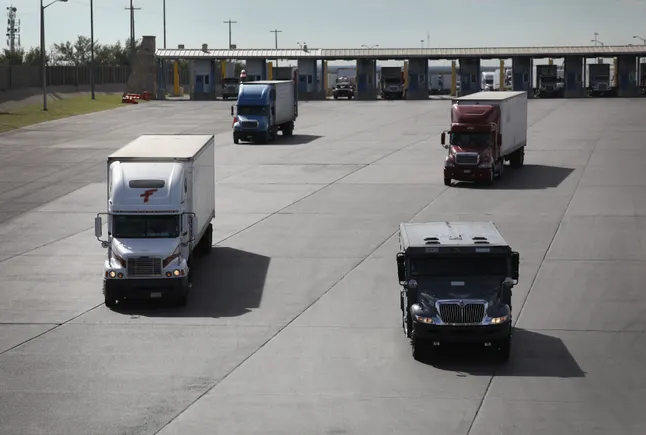
Logistics companies enhance border crossing capabilities as manufacturers expand in Mexico
Recent announcements of investments in Mexico and in Eagle Pass and Laredo, Texas
For example, Union Pacific Railroad earlier this year partnered with Canadian National Railway and Grupo México Transportes to launch the "Falcon Premium" Mexico-to-Canada intermodal service. The service connects parts of their networks, supporting the transport of automotive parts, food, and temperature-controlled goods.
Union Pacific's trucking partner Hub Group is also expected to benefit from the arrangement.
"We're very excited about the new southern premium service just launched by our western partner Union Pacific," Hub Group President and CEO Phil Yeager said on thefirst-quarter earnings callin April. "I think this will really help us capitalize on nearshoring opportunities, both in the short term and the long term."
The Falcon Premium combination faces stiff competition from Canadian Pacific Kansas City Railway, which is the first single-line railroad connecting the U.S., Mexico, and Canada, and hasestablished a partnership with trucking provider Schneider National。
Schneider's intermodal business in Mexico currently represents "only a small portion of our business," Executive Vice President and Chief Financial Officer Stephen Bruffett said on theearnings callin November, but the business is growing. Order volumes for the carrier's round-trip services with CPKC in Mexico have grown 20%.
"The growth percentage is higher, and the overall Mexican market is growing faster, thanks to nearshoring," Bruffett said. "So the incremental volume is still relatively small, but we see a bigger long-term opportunity."
This forward-thinking mindset is prevalent among many carriers, who are adjusting their vast networks to adapt to a new era of supply chains.