
Trucking industry helps feed millions in Florida after Hurricane Ian
After Hurricane Ian made landfall in Florida, volunteers such as truck driver Joe Myerly, through organizations like Operation BBQ Relief, overcame road obstacles to transport food and supplies, supporting a large-scale meal effort. The American Logistics Aid Network and others provided transportation and refrigerated trailers, helping the nonprofit achieve a supply of 60,000 to 80,000 meals per day, with plans to eventually reach 100,000 daily, for a total goal of one million meals.
On September 28, the day after Hurricane Ian made a deadly landfall in Florida, Joe Myerly, a 55-year-old truck driver, drove a flatbed truck carrying five large meat smokers and a dry van loaded with kitchen supplies to downtown Port Charlotte in Charlotte County.
Myerly said emergency responders on rescue boats, who were saving residents trapped in their homes, had blocked off a highway exit. He passed these rescuers as he traveled from a staging area on the Georgia border through dangerous roads after the Category 4 hurricane, eventually delivering the needed supplies.
"The first four or five days were completely like running an obstacle course," said Myerly, from Hagerstown, Maryland. "It's getting better now, but there's still a lot to clean up... Power poles are down, trees are across the roads."

Myerly is part of a volunteer team for Operation BBQ Relief, a disaster relief nonprofit, helping the organization set up and supply a free feeding site aimed at providing at least one million hot lunches and dinners to Floridians in need after the storm.
Since its founding in 2011, the nonprofit has relied on truck drivers like Myerly to support its post-disaster food distribution efforts. And after Hurricane Ian, the extra boost from the trucking industry is supporting the organization's largest response to date.
The American Logistics Aid Network—a transportation industry nonprofit formed after Hurricane Katrina—provided transportation services, refrigerated trailers for food storage, and other free assistance. Operation BBQ Relief officials said this help was crucial in scaling the feeding site to 60,000 to 80,000 meals per day.
"They have been a godsend to us," said Chris Huggins, director of logistics and transportation for Operation BBQ Relief.
"A lot of food is needed"
On September 30, flooding forced the closure of Interstate 75, temporarily stranding Myerly in Florida while the feeding site was being set up. After the highway reopened, he immediately set out again, hauling pallets of canned vegetables, food containers, and other supplies from Texas, South Carolina, and Georgia.
"It takes a lot of food," Myerly said.
According to Huggins, just last week, the nonprofit sourced green beans from Wisconsin, mixed vegetables from Virginia, bread from Nebraska and Kentucky, and beef brisket from Arizona.
Huggins lives in Dallas and works as a freight broker during the day. But as director of logistics and transportation for Operation BBQ Relief, he shifts his focus from hauling building materials to food and agricultural products.
"We have products from all over the country, some purchased from suppliers, some donated by suppliers," he said. "During these disasters, our transportation costs can sometimes exceed $150,000."
That's where the American Logistics Aid Network and its executive director, Kathy Fulton, step in to help. Huggins and Fulton work together to coordinate what needs to be shipped, while Fulton works with the network's partners to move goods for Operation BBQ Relief at no cost.
Building bridges and air support
Fulton said the requests from Operation BBQ Relief and other nonprofits to the American Logistics Aid Network vary, but the biggest are transportation needs, ranging from less-than-truckload to full truckload shipments.
"We sit right in between organizations, helping push information and resources to where they need to go, and trying to build bridges so that the network can function without us," Fulton said.
In addition to working with the trucking industry, Operation BBQ Relief partnered with Texas-based nonprofit Operation AirDrop to fly food to areas cut off by flooding, such as Fort Myers and Sanibel Island.
"We're sending meals to many different counties," said Joey Rusek, operations manager for Operation BBQ Relief. "We worked with them to airlift about 20,000 meals over three days."
"Perfect timing"
Cars lined up at Operation BBQ Relief's free feeding site because more than half of Charlotte County residents were without power, said county spokesman Brian Gleason.

"These people haven't had a hot meal in a long time, unless they made it themselves on a grill, if they still have one," Gleason said. "The food in their refrigerators went bad long ago... This is a great program, and the timing couldn't be better because people are really struggling."
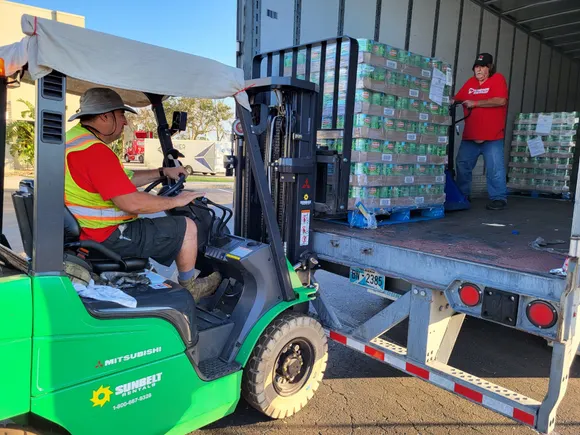
On Friday morning, Myerly operated a forklift at the rear of his trailer, slowly moving the latest shipment—a pallet of Del Monte canned green beans—toward the forklift of waiting volunteer Forrest Parks.
That evening, he hit the road again for Alabama to meet another driver and pick up a load of corn.