
Union Pacific and Norfolk Southern say merger will shorten full-truckload transit times, but shippers remain skeptical
Union Pacific and Norfolk Southern say the merged network can cut full-truckload transit times for east-west gateway exchanges by up to two days, while improving reliability and reducing costs. However, some shippers, citing precedents where previous mergers failed to deliver on service commitments, are skeptical of these expectations. Experts note that interchange delays and insufficient volume at gateways like Chicago may hinder the realization of direct services.
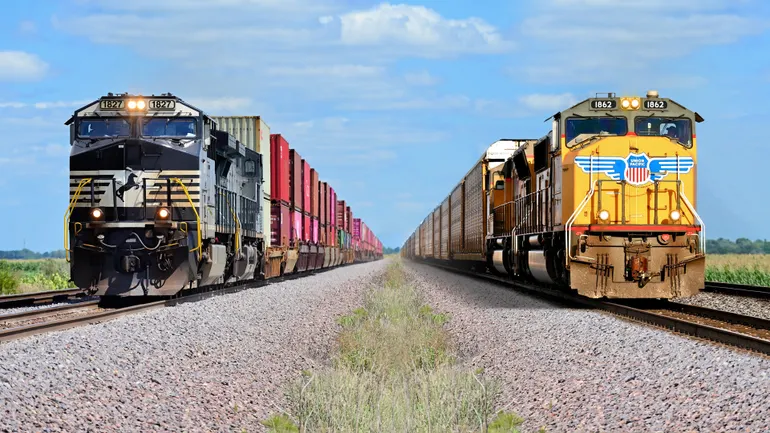
Union Pacific (UP) and Norfolk Southern (NS) said the combined network is expected to accelerate the movement of various types of freight, with carload traffic projected to benefit the most.
For carload freight that currently requires interchange at east-west gateways such as Chicago and New Orleans, transit times could be reduced by up to two days. The companies said this would make rail more competitive with trucking while improving reliability and lowering costs for shippers. Additionally, faster service should translate into lower inventory carrying costs and help customers reduce their railcar fleets.
But some shippers are skeptical, citing past mergers that failed to deliver on promised service improvements.
How UP and NS plan to speed up carload traffic
The potential reduction in transit times is expected to be most significant for carload freight that currently requires the most handling and often faces the longest interchange delays at east-west gateways like Chicago.
In theory, a merged transcontinental railroad could speed up carload traffic by eliminating interchange delays and controlling the end-to-end service design of railcars from origin to destination. For example, UP CEO Jim Vena said in an August interview that for lumber moving from sawmills in the Southeast served by NS to dealers in the Phoenix area served by UP, UP could eliminate up to four intermediate handling events.
Reducing the number of car handlings should improve service reliability by lowering the chance of missed train connections, said C. Tyler Dick. It should also improve equipment utilization because cars move through the system faster and more consistently. However, Dick noted that despite dozens of mergers since 1980 creating the modern rail network, carload transit times and car utilization have not improved significantly.
"However, previous consolidations did little to improve the key east-west gateways, which is what the UP-NS merger is counting on," he said.
Experts remain skeptical of service promises
Despite the railroads' ambitions, their connections in Chicago and other gateways may temper hopes for service improvements. A veteran retired railroad executive familiar with Chicago terminal operations and practices, who spoke on condition of anonymity due to the sensitivity of railroad operations, said these interchange points have historically been a source of uncertainty due to frequent congestion and limited crews.
The retired executive cited an example where a North Platte-to-Bellevue train has two route options when crossing Chicago. One is under UP-NS control but faces peak-hour conflicts with commuter trains; the other does not conflict with commuter trains but is not entirely controlled by the two railroads.
"Keeping trains moving at interchange points, even slowly, can save more than 24 hours," the executive said in an email. "However, UP and NS have poor connections at most interchange points, especially in Chicago, so these savings are not automatic."

Overall, rail mergers have not delivered on their service-related promises, Chris Jahn, CEO of the American Chemistry Council, said in an interview. Jahn said that in theory, single-line service should shorten transit times and allow shippers to use fewer railcars. "But we haven't seen that in reality," he said of past mergers.
A rail logistics manager at a major energy company, who spoke on condition of anonymity for fear of railroad retaliation, agreed. The logistics manager said past mergers did not bring transit time reductions significant enough to allow the company to shrink its tank car fleet. "You have to look at it on an origin-destination pair basis," the logistics manager said in an interview. "There are incremental improvements here and there, but at a macro level, I don't think it's significant."
The logistics manager noted that railroads today are not incapable of running direct run-through trains, mentioning that 25 years ago all Class I railroads routinely ran trains deep into each other's networks. But since 2000, eastern carload volumes have fallen by more than 20%, according to data NS and CSX provided to the Association of American Railroads. "Whether UP and NS merge or not, volumes between city pairs are not sufficient to support seamless direct trains across Chicago," the logistics manager said.
Where volumes exist, other railroad combinations have successfully launched direct routes that shortened carload transit times. Carload traffic in western Canada has boomed thanks to growth in petrochemical and energy-related freight such as frac sand, steel pipe, and natural gas liquids. To that end, Canadian National (CN) and NS launched two pairs of run-through merchandise trains in 2017 between CN's Winnipeg, Manitoba yard and NS's Elkhart, Indiana yard. The direct route leverages CN's unique corridor that bypasses Chicago, avoiding Chicago hub congestion and saving 48 hours compared with previous interchange arrangements.